How would our lives be different if a hundred years ago, our top physicists told us the universe was merely a stubbornly persistent dream, and we are all just dream characters of a single universal dreamer? Amazingly, this did happen. They may not have put it quite in those terms, but that was the implication. In response, the rest of the scientists barricaded themselves behind a stern allegiance to materialism. But, imagine if today we all knew our neighbor as ourselves. How would our lives be different?
Materialism argues that consciousness arises from matter, therefore it can only behave like matter; it can never experience, or move, or gain knowledge in any nonlocal way. But we now know matter itself arises from nonlocal quantum fields. And yet, scientists still insist that consciousness is limited to the old Newtonian rules of matter, and that none of the new quantum rules apply. They would say the brain is too warm and noisy to allow access to anything quantum. To do this, they must conflate consciousness with the mind, the mind with matter, and matter with Newtonian matter.
This whole reductive programme – this mindless materialism, this belief in something called ‘matter’ as the answer to all questions – is not really science at all. It is, and always has been, just an image, a myth, a vision, an enormous act of faith. As Karl Popper said, it is ‘promissory materialism’, an offer of future explanations based on boundless confidence in physical methods of enquiry. It is a quite general belief in ‘matter’, which is conceived in a new way as able to answer all possible questions. And that belief has flowed much more from the past glories of science than from any suitability for the job in hand.
–Mary Midgley
Science doesn’t always get it right at first, and some mistakes get embedded for generations. For example, do you still believe the savanna theory of human evolution?
There are scientists who are less constrained by old cultural biases. For example, Daryl Bem, a renowned Cornell professor, has followed the evidence and risked his reputation publishing on Psi experiments, while other great researchers are working mostly outside orthodox science, such as Rupert Sheldrake and Dean Radin. This century old paradigm shift has stalled some, but it is still the way forward for science.
Robert Lanza: The Theory of Biocentrism, Part 1 | YouTube 18:38
The universe is nonlocal, except in the loci of awareness in all lifeforms. Isn’t it possible that consciousness has a nonlocal side as well? For thousands of years meditators have described nonlocal experiences. Mainstream science seems convinced this is impossible, otherwise they would be doing it themselves.
First, we discovered the universe was created (13.8 billion years ago), and now we’ve learned it was created astonishingly fine-tuned. Somehow, at least 32 physical constants were set in place, which continuously define our universe. Ten of them are so finely-tuned, even a slight deviation in one would keep matter from forming—no stars, no planets, no life. Furthermore, they are delicately tuned to each other. The odds of this is astronomically small; like 1 in 10^229 small (Steve Brusca, 2001). The obvious conclusion is that it was designed to be this way. Just the fine structure constant being precisely where it is allows for atoms to form and share electrons, allowing chemistry to happen, and stars and planets to form. A famous top physicist, Richard Feynman said about the fine structure constant,
It’s one of the greatest damn mysteries of physics… You might say the “hand of God” wrote that number… –Richard Feynman
That’s why scientists don’t say much about this amazing discovery. They even delayed publishing on it for years (Steve Brusca, pers. comm.). The problem is, to maintain a materialist view, scientists needed to explain this precise fine-tuning away. They suggested it could have evolved from a very long ancestry of universes; or maybe the laws of physics do change across an infinite universe, and we are just in a sweet spot; or it could be that many universes were created, and we are just in the good one. The first and last ideas don’t require infinity, just more universes than there are atoms in the known universe; keeping them in contention for the least parsimonious theories ever conceived by man. And they still don’t eliminate the need for a creator of some kind. It’s a big can of worms, so scientists tend to keep quiet about this huge discovery. Yet the fact remains that the astonishingly precise tuning of our universe strongly suggests it was somehow designed to allow life to exist. It’s really quite striking. Making spice cake requires the right ingredients, in the right proportions, and cooked just right. Our universe is impossibly more fine-tuned than that. Where did all these physical constants come from? What has been governing them to this day? It’s a topic limited mostly to Closer To Truth, and Christian apologetics?
Quantum biology is a new discipline studying how lifeforms utilize quantum effects. Science is learning how to make use of the quantum effects—giving us transistors, lasers, and quantum computing—but life has been doing it all along.
For example, quantum tunneling explains how enzymes are able to speed up chemical reactions in our body, as well as accounting for the sense of smell. And birds appear to be using entanglement to visually see the earth’s electromagnetic field, explaining their uncanny ability to navigate. And plants are able to control quantum superposition to gather light in photosynthesis. Our bodies have long evolved to take advantage of our quantum nature, but science is only starting to discover its usefulness.
How Quantum Biology Might Explain Life’s Biggest Questions – Jim Al-Khalili | YouTube 16:09
So, what about consciousness? Mainstream science would say the brains of living organisms are too “warm and messy”, too noisy to allow access to quantum processes, since they must freeze quantum computers to near absolute zero to minimize heat motion. But now we know that life uses quantum process all the time. Furthermore, consciousness is not warm and messy; the brain is. Why can’t consciousness have its own direct access? Mainstream science hasn’t a clue of what consciousness is, and yet it is quite confident that consciousness can’t access its own nonlocal substrate. Meditators would beg to differ.
What is the nature of existence? Surprisingly, the answer is knowable. In fact, it’s so well known they call it the perennial philosophy. It’s the idea that, at the core of our being, we are all One.
This may sound like religious wishful thinking, but it is also scientifically well supported, philosophically sound, and personally verifiable. We are here by some means, and this is it.
The answers to the big questions are knowable, not by our intellect, but because the source of the world happens to be what we are; consciousness. Waking up to this in a physical body is the goal of evolution, and humans have evolved just enough to achieve this.
The world is the wheel of God, turning round and round with all living creatures upon its rim. -Shvetashvatara Upanishad
Religions often symbolize our condition with a circle or a tree; a many-to-one relationship representing our true nature. The perennial philosophy is just pointing out that there are many paths leading to this realization. Even preeminent scientists can agree …though usually in private.
A human being is a spatially and temporally
limited piece of the whole…an optical
illusion of his consciousness. The striving
to free oneself from this delusion is the
one issue of true religion. –Albert Einstein
Why are we here?
Where do we come from?
Where are we going?
Answer:
There is an infinite, changeless reality
beneath the world of change.
This same reality lies at the core of
every human personality. The purpose
of life is to discover this reality
experientially—that is, to realize
God while here on earth.
-Eknath Easwaran
ARGUMENT FOR THE PERENNIAL PHILOSOPHY
Our human senses and cognitive abilities are limited, but we can still be certain there is something rather than nothing. For there to be anything, something outside this causality must have caused all this, since nothing ever comes from nothing (note that empty space is not nothing).
With the discovery of the Big Bang, science agreed there was a causal starting point. The universe was created, somehow. But then, quantum mechanics came along, and the physical determinism of the Big Bang was replaced the indeterminacy of quantum mechanics. Now the relevant question is: What’s keeping the lights on today? What is sustaining the quantum fields that generate the appearance of this physically deterministic universe. It’s not as though science knows what quantum fields are, or what causes them.
What is it that breathes fire into the
equations and makes a universe for
them to describe…Why does the universe
go to all the bother of existing?
–Stephen Hawking
So, we can say with great certainty that something outside of time and space must be the cause of this spacetime.
Time, nature, necessity, accident,
elements, energy, intelligence—none
of these can be the First Cause.
They are effects…
-Shvetashvatara Upanishad
But there still may be a big bias in our way. Western science works with quantitative data only, and ignores qualitative experience. Because of this, we’ve come to believe the data is more real than the experience. We have forgotten that all experiences only ever happen in consciousness. This misunderstanding eventually leads back to the Hard Problem of Consciousness.
In reality, the only thing we can be absolutely certain about is our own consciousness. That is to say, information from our mind and sensory perception is less reliable than the certainty of our own conscious awareness. We see the world through limited human senses, and our perception of it is less than perfect, but we can always be absolutely certain that we are witnessing it.
I am, I exist, is necessarily true
each time that I pronounce it,
or that I mentally conceive it.
–René Descartes | Meditation II
If we adjust the wording a little, we can now be absolutely certain about our conclusion:
Something outside of time and space must be the cause of this conscious experience.
This is essentially the Cosmological Argument (a form of perennial philosophy), which was the worldview of Western science, from Aristotle (350 BC) to the 1700’s—when materialism became popular, replacing the ancient Parmenidean monism and Plato’s forms with matter itself being most fundamental.
But now, modern science is pointing back toward the perennial philosophy; the idea that consciousness is fundamental. Quantum mechanics tells us the universe only exists in experience, and otherwise resides as wave functions. So why all the resistance? With such a parsimonious explanation of the universe, the most skeptical of scientists should be all for it.
But, be advised: Concepts can be helpful, but they are just prep for direct experience.
Of course, if you still think consciousness is a random anomaly of matter ultimately caused by the Big Bang, then this conclusion would not satisfy you.
SO, WHAT IS CONSCIOUSNESS?
It’s what we are.
How does something as immaterial as consciousness arise from something as unconscious as matter? -David Chalmers
Consciousness is fundamentally different from everything else. It’s not just different from mass, energy, space, and time, it’s also different from thoughts, feelings, intuitions, and memories. Those are things that happen in consciousness. Without consciousness what good are thoughts? In the West we conflate consciousness with thinking because we misinterpret Descartes. He didn’t really say, I think, therefore I am.He said, thinking is happening, therefore I must be an entity that thinks.
Our mental abilities are clearly a function of our human brain, but our conscious awareness, inherent to all lifeforms, is still a complete mystery to science. And that is what we really are. What are we when we’re unconscious? Our mind and body are earthly accumulations, but we are the conscious witness which has accumulated it. When we meditate—look back toward consciousness—we find it’s behind everything.
It takes some understanding to distinguish
between awareness and conceptualization.
It is said that the scope of
conceptualization is very limited,
whereas awareness pervades all that exists. -Gen Lamrimpa
We can’t assume the brain causes it because we see conscious behavior in organisms that that don’t have a brain. Also, science can’t explain how life started on earth, but they do know it started as soon as conditions became available. So, given that everything is caused by something, and that consciousness is so distinctly different from everything, isn’t it possible that it has its own unique cause? Why isn’t that still a reasonable consideration?
I think that modern physics has definitely
decided in favor of Plato. In fact the
smallest units of matter are not physical
objects in the ordinary sense; they are
forms, ideas which can be expressed
unambiguously only in mathematical
language. –Werner Heisenberg
WHERE ARE WE GOING?
Nowhere, until we can see past materialism.
Every man takes the limits of his own field of vision for the limits of the world. –Arthur Schopenhauer
This materialist view is the common sense view of physical determinism—that matter is fundamental, and consciousness is an epiphenomenon of the brain (matter), ultimately caused by the physical and chemical chaos of the Big Bang. And since time only began flowing as a result of the Big Bang, there is no chance of finding a first cause. It could be said that,
Modern science is based on the principle:
‘Give us one free miracle and we’ll explain
the rest.’ -Terence McKenna
Something can’t come from nothing, so the Big Bang theory still requires a cause. There must still be a super-space, or a mother universe; some place where a universe like ours can emerge from.
Because of the 200-year divergence physics took into materialism that ended a 100 years ago, most people still think science proved materialism explains the universe. It doesn’t. On the contrary. Materialism has been proven ontologically false for a century now.
Scientific materialism sees the world from only the body side of Descartes’ mind/body dualism, which is a philosophically weak position. Arguing from just the physical side, they are unable to explain many things—like the probabilistic nature of quantum mechanics, or how the universe is relative instead of objective, or even consciousness. In materialism, everything is physically deterministic (no conscious volition) so they must accept that consciousness itself is an illusion. But again, that’s because they are interpreting the world while limited to just the physical side of Descartes’ dualism. A further complication is that Cartesian dualism was never really about mind & body, but mind-body & consciousness. How much has that misunderstanding cost us?
If the fundamental building blocks of matter turned out to be physical, that would have given materialism a leg to stand on. But instead, physics found a fuzzy edge of reality where matter transitions into mathematics. So, matter is not fundamental. It’s a phase of quantum probability fields. Particles are how wave functions appear to us, though they never do fully exist in spacetime. In my opinion, quantum mechanics is studying the noumenal realm of Kantian philosophy. Clearly, physical spacetime reality has been shown to be not fundamental.
The Measurement Problem is a big problem for the materialist position. In quantum mechanics, the particles that make up matter always behave as probability distributions (wave functions) until observed, and only then do they transform into a particle in spacetime. To put it in physics parlance, to make a Heisenberg cut in the von Neumann chain you need a extra-physical element like consciousness. The Copenhagen Interpretation is by far the most widely held and experimentally supported interpretation of quantum mechanics, and it says the observer collapses the wave function. All objections to this view have provided no evidence. Clearly, observation plays a critical role in the emergence of matter. Once again, ontological materialism has been proven wrong.
A century ago, science discovered that consciousness causes the world to manifest by collapsing quantum states into physical reality. Therefore, the brain can’t cause consciousness, because consciousness causes the brain.
Mind no longer appears to be an accidental
intruder into the realm of matter…
we ought rather hail it as the creator
and governor of the realm of matter.
–Sir James Jeans
To make of the brain the condition on
which the whole image depends is in
truth a contradiction in terms, since
the brain is by hypothesis a part of
the image. -Henri Bergson
Meanwhile, materialists have spent the last century not advancing science, while no progress has been made on how electro-chemical states in the brain can give rise to conscious experience. Consciousness is regarded as an epiphenomenon. One favored theory is that it’s an emergent phenomenon caused by the vast integration of information in our large brains. But then why do all organisms, even as simple as a single cell, behave consciously?
The philosophy of the perennial philosophy is actually ontological idealism, which is well supported by modern physics, yet we still think scientists should be materialists. For an in-depth look, consider this 2-hr YouTube of an ontological idealist interviewed by a famous materialist:
Bernardo Kastrup on the Nature of Reality: Materialism, Idealism, or Skepticism | YouTube 2:14:21
IF WE ARE ONE, THEN WHY DON’T WE KNOW IT?
Because we don’t meditate.
Brahman cannot be realized by those
who are enmeshed in life’s duality.
-Tejobindu Upanishad
Delusion arises from the duality of attraction and aversion. -Bhagavad Gita 7:27
Desire and aversion blind you to Suchness.
-Xinxin Ming
Don’t copy the behavior and customs of this world, but let God transform you into a new person by changing the way you think. -Romans 12:2
Born into a world of individual bodies, we learn to see ourselves as separate. By the age of three we develop an ego, and learn how to fulfill our egoic desires within the hierarchy of egos around us. This process is necessary for living in the world, but it hides our true nature, like clouds obscuring the sun.
This process of identifying with the egoic self is the topic of the Garden of Eden story. When Adam and Eve lived in the garden, they knew themselves to be God; both immanent and transcendent (egoic self and transcendent Self). But after living as individuals for, let’s say, three years, they forgot their transcendent nature, and began to only identify with their egoic selves—symbolized by eating fruit from the tree of duality, and suddenly becoming self-conscious.
The thought, “I am the doer,” is the bite of a poisonous snake. -Ashtavakra Gita
Forgetting their transcendent nature, they lost their identity with God, the animals, the garden, and found themselves in a world of separateness. This is our condition. But the way back to the garden can be as easy as looking inward in silent meditation. It’s just, most people don’t know this.
The Brihadaranyaka Upanishad says it most clearly: Separateness arises from identifying the Self with the body. The story of the Garden of Eden is meant to remind us of our true nature—that we are not just our mental and physical accumulations (the egoic self), but also our higher Self.
How Judaism and Christianity Differ on the Original Sin | YouTube 3:35
This realization feels like being born again, or waking up from a dream, but it’s not the egoic self that wakes up (this can be very destabilizing if the necessary prep work hasn’t been done). All the true religions are really just about this one thing.
There is only one Self in all creatures. The One appears many, just as the moon appears many, reflected in water.
-Amritabindu Upanishad
As long as we think we are the ego,
we feel attached and fall into sorrow…
When you realize that you are the Self…
you transcend the duality of life
and enter into the unitive state.
-Mundaka Upanishad
Brahman is all, and the Self is Brahman.
-Mandukya Upanishad
Consciousness is the Self.
-Shiva Sutras
I say, ‘You are gods; you are all
children of the Most High…’
-Psalms 82:6 | NLT
Tao is your very nature.
Seeing this, everything is clear –
you walk free and undisturbed as Tao.
-Xinxin Ming
Remove the veil.
You will find your beloved within.
In every heart the Lord dwells.
Therefore, speak no bitter words.
The one who listens within you
Also listens within everyone else.
-Kabir
God dwells within you as you.
-Swami Muktananda
That one God who shines within everything, Who is formless like the cloudless sky, Is the pure, stainless, Self of all. Without any doubt, that is who I am.
-Avadhuta Gita
I am not the mind. I am not the intellect or
intelligence. I am not the ego, nor am I a
deeper self or soul…I am Absolute
Awareness of Eternal Love and Bliss.
-Atma Shatakam
You are the Solitary Witness
of All That Is, forever free. Your only bondage is not seeing This.
-Ashtavakra Gita
Lord! I’ve never known who I really am,
or You. I threw my love away on this
lousy carcass and never figured it
out: You’re me, I’m You. All I ever
did was doubt: Who am I?
Who are You? -Lal Ded
Believing appearances are real, you cannot see their Source. -Xinxin Ming
What discovering the quantum realm was like
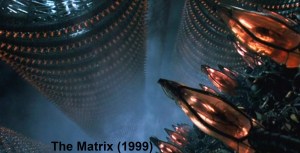
Physics underwent a paradigm shift so worldview shattering, they don’t like talk about it. They found a substrate to physical reality, and it’s information written in a mathematical language. The physicists who made this discovery began to draw parallels with Eastern mysticism in their publications. That’s when the rest of the physics community became philosophically quiet, but with a renewed interest in verification. Ontological speculation became taboo, and by the 1950’s, a “shut up and calculate” policy was established in universities across the West, effectively removing philosophy from physics. Why? Because all their experiments keep verifying that we are living in a dream world. …Neo.
Position and velocity are what you can observe. But until you measure them, they don’t exist. Only the wave function does. -Sean Carroll
Ontologically, the scientific community is still sheltered by the legacy of materialism—the commonsense view of a physically deterministic objective universe existing independent of observation. Who would argue against that? Even Einstein’s general relativity needs matter in space to make gravity. But there’s a significant problem with this intuitive view. It’s been proven ontologically wrong by the last century of experimentation. All matter is actually wave functions. Wave functions are not physical waves, but mathematical functions like y=x+3. The structure of the universe is math on the outside, consciousness on the inside.
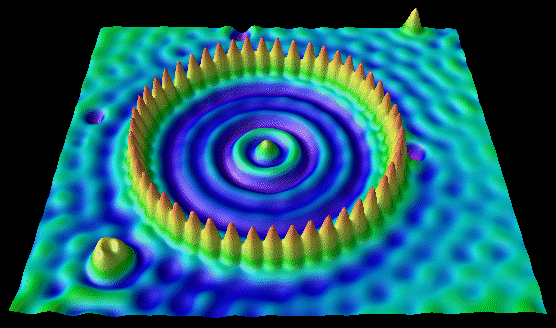
Tunneling map of unobserved electron wave functions entangled into standing waves.
A wave function is just a mathematical record of the probability zone where a particle will emerge from the math if observed. Wave functions can shrink down to near the size of particles, which allows them behave essentially as particles (note in the above image how small the iron wave functions forming the corral are). When not observed, wave functions behave according to the strict determinism of mathematics, which appears to us as physical determinism. The quantum probability part we always hear about, happens at observation. But for the rest of the time, the universe evolves according to the mathematical precision of quantum determinism.
This has led to an insurmountable problem for the commonsense view of an objective world outside of observation. The problem is, there is no experimental evidence for objective collapse (of the wave function into particles of matter), and a century of evidence for subjective collapse. So, matter doesn’t exist otherwise. The weight of this evidence is summed up as the Measurement Problem. To deal with the problem, physicists merely altered the meaning of the word “observer” (from the Copenhagen interpretation) to include “measurement,” which doesn’t require an observer. That way, the environment can collapse its own wave functions, allowing for physical determinism to proceed without observation. This is conflating decoherence with collapse, but it lets us think of the Big Bang as an explosion of particles in expanding space, instead of a storm of wave functions in quantum fields. And we get to think of rocks as objectively physical, instead of tightly entangled groups of wave functions that only become physical in the experience of them—along with their history going back to the quantum storm of 13.8 billion BC. Crazy that. But this is what a century of experimentation keeps telling our physicists. It’s a quantum universe. There is no objective, independent spacetime, and physical objects don’t have physical properties before they are observed.
We are participators in bringing into being not only the near and here, but the far away and long ago. –John Wheeler
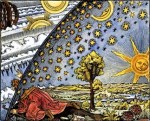
For two-thousand years, Western science assumed God created heaven and earth. Then, for 200 years and ending 100 years ago, the evidence pointed toward the nihilistic universe of materialism when they discovered that the world is not the center of the universe, but one planet among billions, spinning like a top while getting dragged around by a star in a galaxy of the Virgo supercluster. But now, a new science has seen past all that, and is pointing back toward a universal consciousness. Modern experiments tell us our consciousness acts like a catalyst, localizing wave functions into our experience of the physical world from an otherwise nonlocal realm. Why would that be? The simplest explanation is, our consciousness is this nonlocal consciousness, just localized into a body; compartmentalized and disassociated from the rest of ourselves—like in a dream we are always looking out toward our mind & body, we never notice our nonlocal inner nature. Top physicists realized this a century ago. Before it became taboo, this is how they talked about it:
As a man who has devoted his whole life to the most clearheaded science, to the study of matter, I can tell you as a result of my research about the atoms this much: There is no matter as such! All matter originates and exists only by virtue of a force…We must assume behind this force the existence of a conscious and intelligent Mind. This Mind is the matrix of all matter. –Max Planck
The universe is of the nature of a thought or sensation in a universal Mind…The stuff of the world is mind-stuff. –Sir Arthur Eddington
The universe does not exist “out there”, independent of us. We are inescapably involved in bringing about that which appears to be happening…Today we demand of physics some understanding of existence itself. –John Wheeler
Is this loosening the grip your default worldview has on you? Then it’s good prep work for meditation.
WHAT ARE WE?
We are consciousness. Our mind and body are earthly accumulations. Scientists found the building blocks of our accumulations to be a mathematical language in the form of quantum wave functions. That there is a mathematical language giving rise to reality tells us there is consciousness on the other side of wave functions as well.
This explains why the universe is so mathematically oriented; why math works so well in the classical world. The world is so obviously mathematical, Pythagoreans were saying it 2,600 years ago. Everywhere you look, the world is built on the fine structure of mathematics. Sometimes, the same formula will even work in more than one area of physics. The famous Schrodinger equation of quantum mechanics is essentially a heat flow equation borrowed from classical physics. That’s nuts. A great example from our classical world is the Golden Ratio. It was always obvious, but when modern physics came along, it confirmed the world is indeed a mathematical construct. Modern-day physicists just don’t publish much on the subject:
…the enormous usefulness of mathematics in the natural sciences is something bordering on the mysterious and that there is no rational explanation for it. -Eugene Wigner | The Unreasonable Effectiveness of Mathematics (1960)
If you think quantum mechanics sounds more like a simulation than a dream, I agree. It is a simulation (as opposed to a model), but it’s still a dream, because we are real. For all we know, wave functions are brainwaves. The real question is, is the consciousness that’s behind the simulation another being, or consciousness itself? Each component in the simulation is governed by a model (a wave function), which describes its location and shape within the rules (Hamiltonian) of the simulated environment (Hilbert space). It is a simulation for sure, but we are real. If it’s just a being like us behind the simulation, then there must be a real universe to house this being, and the simulation theory just inherited all the problems of materialism. If it’s that our consciousness is being piped into the simulation, then billions of us humans, along with the countless lifeforms of earth (can’t all be NPCs) must be accounted for outside the simulation, and that gets messy.
That’s why simulation theorists tend to argue the simulation itself generates our consciousness. But how can a simulated (mathematical) brain make real consciousness? Real brains can’t even do that. Quantum mechanics tells us consciousness makes matter out of math, not the other way around.
In contrast, the view that consciousness itself is behind the simulation, deals with the First Cause Argument, solves the Hard Problem of Consciousness, the Measurement Problem, explains all phenomena, has far fewer assumptions than all other alternatives, and is personally verifiable. If your consciousness is what’s most real, then maybe consciousness is what’s most real.
Why isn’t this common knowledge? Because no scientist wants to defend such a position. It’s counterintuitive, abstract, anthropocentric, and sounds like religious wishful thinking. It’s far less controversial to suggest there must be some means of objective collapse, allowing the universe to physically unfold from the Big Bang. Too bad, really. Society could have used the good news.
Whatever exists, animate or inanimate, is born through the union of the field and its Knower. -Bhagavad Gita
Matter (mass-energy) is a property of three quantum fields (up quark, down quark, electron) held together by two quantum fields (electromagnetic, strong nuclear). Physicists have no idea what causes these fields, but they can predict wave function behavior so astonishingly well with mathematics, the wave functions themselves are clearly mathematical. And in this sense, they are deterministic (again, the quantum probability part only has to do with observation). So, the deterministic nature of our world is not physical, but mathematical. When this was first published (1926) the author was concerned about how probabilities are mathematical, not physical. This problem has never been resolved.
It really is mathematical. The quantum rules describing the universe (the Hamiltonian) only make sense if you think of them operating within a mathematical space (Hilbert space). Mass is a property of quantum fields; not of wave functions or particles—the wave function only locates the particle in space, but the field it belongs to dictates the particles properties. So, what is a particle? The quantum realm is a variable-dimensional space (likely infinite dimensions), where imaginary numbers are real, and time doesn’t exist. Mass, charge, and spin magnitude are just numbers (constants) in formulas. A quantum field is a Hilbert space. The true state of the universe is a high-dimensional mathematical space. One example: The spin–orbit interaction parameter, must know and use the tensor-product structure of the Hilbert space in its formula—It’s behaving in ways that are clearly mathematical. The point is, science discovered the true structure of the universe, and it’s mathematical. Why would that be?
The fact that you cannot separate the original matter from the deeper reality tells you this is a monism. – Federico Faggin
Physicists still like to say you don’t need an observer, just a measuring device to collapse the wave function into a particle. I disagree. There is nothing intrinsically different from the sample and the measuring device; they are both matter. On its own, matter resides in quantum superposition, and if we were only matter, we would exist in superposition as well. But since we don’t, there clearly must be something intrinsically different about us (lifeforms), an extra-physical element, that causes physicality. The obvious difference is, we are conscious. Why all the confusion about this?
A measurement without an observer is just decoherence of the superposition, and not collapse of the wave function. Decoherence and collapse can appear to be the same from our perspective, in that a measuring device can measure a mathematically precise outcome while still in superposition, but one is physically in spacetime and the other is not. It’s more correct to think of the objects in the universe as fields of structured quantum probabilities, rather than a collection of particles. Only the observed parts reduce to particles.
Classical systems have localized wave functions that approximately obey classical equations. -Sean Carroll on the Ehrenfest theorem
What does the Heisenberg Uncertainty Principle tells us? It’s another proof that particles are a mathematical illusion. When observed, wave functions collapse into aspects of particles only; never complete particles. If you could know a particles exact velocity, it’s position would be a flat distribution across the universe—everywhere and nowhere. It’s confirmation that everything is wave functions, and particles are what happens when we interact with them.
What did we learn from the double-slit experiments? They conclusively demonstrate how light and matter operate in Hilbert space (a mathematical realm) until they are observed—proof that physical objects only exist in the experience of it. If you try to view the delayed-choice experiment from a classical spacetime perspective, it generates the paradox of retrocausality, telling us it’s an incorrect perspective. The results only makes sense if you think of light “moving” through the apparatus as a wave function, not yet in time or space. Likewise, sunlight in your room does not propagate through your room, but as information in Hilbert space. Matter rests in Hilbert space too. It only transitions into spacetime in the experience of it. The double-slit experiments prove the world is an illusion (māyā).
We are mixed up about the word entanglement—how wave functions combine to make the classical-scale objects we experience. The quantum entanglement everyone talks about (SPDC entanglement) is when a single wave function is split into two particles, allowing them to relate to each other at paradoxically faster than light speeds. But the far more common version of entanglement is when different wave functions interact with each other to make all the classical-scale physical objects we know and love—like ripples on a pond interacting to make more complex patterns. They call this form of entanglement, decoherence, and it’s how unobserved history develops deterministically while remaining in superposition (not physically in spacetime).
Quantum applies to all scales. The very reason why scientists were looking into quantum scales was to see what matter is made of. In that endeavor, they were successful. But what they found was crazymaking. The building blocks of matter turned out to be an elegant mathematical language operating outside of spacetime. And that’s why they’d rather limit their quantum talk to the strange phenomena happening at quantum scales. But the Bell’s inequality experiments of the 1980’s strongly suggested, and now Leggett-Garg inequality experiments of the early 2000’s have confirmed, it’s a quantum universe at all scales. Quantum mechanics explains all classical scale phenomena. Magnets are an interesting example. The force we know as magnetism is caused by the spin of individual electrons in atoms and is in all matter, but it can bleed into classical scales when enough of the electron spins are set into alignment, as in magnetized iron. Magnetism is literally a quantum force bleeding into classical scales. But then, so are all the forces of nature. The way we think about quantum is all wrong. Classical physics is just a mathematical shortcut to model the behavior of large-scale quantum objects. At what size would we even make the break between quantum and classical? In certain conditions, matter can maintain quantum coherence and behave like a single wave function at classical scales. Typically, the more wave functions involved, the less likely they will all be waving coherently together (resulting in decoherence), but there are examples of large-scale coherent objects, such as lasers, superfluids, superconductivity, and Bose Einstein condensates.
To sum things up, mathematical information is currently thought to be the building blocks of all physical objects. Unobserved matter, and even its history, never physically exists, except as qualia in experience. The universe is math on the outside, and consciousness on the inside. What does that do to your worldview?
The rest of this segment just gets into greater detail. Here’s a quick YouTube describing the behind the scenes side of matter:
What Is a Field? – Instant Egghead #42 | YouTube 2:21
This next YouTube beautifully details how a single wave function collapses into particles as they are observed, and how the wave function progresses after collapse. However, be advised: They say the detector is collapsing the quantum states, but that is only decoherence, not collapse. In reality, the detector, as well as its detection history, remain in superposition until collapsed by observation (the Heisenberg chain breaks at observation).
Visualization of Quantum Physics (Quantum Mechanics) | YouTube 14:33
Science has long been wanting to tell us that beneath the surface, we are all one. Below is a Cambridge professor explaining how all the universe reduces to quantum fields (19 minutes into his Faraday’s Fields talk).
Quantum Fields: The Real Building Blocks of the Universe – with David Tong | YouTube 1:00:17
For example, the moment before a photon registers in your awareness, its wave function (in Hilbert space) may span many light years in spacetime. It could have collapsed into the eye of a distant observer on another planet (hypothetically speaking), but the moment it collapsed into your eye, it instantly became unavailable to any other observer, and the entire history of its trajectory became a spacetime event. The only way this information could be conveyed across light years in an instant is if it wasn’t actually a thing in spacetime. Everything in the universe is like this. Before it is observed it is only information in Hilbert space, and not really a thing in the universe.
This quantum substrate has long been described by saints and sages (meditators). For example, the Bhagavad Gita devotes a chapter to quantum fields, and the Spanda Karika (sacred tremor) is a 9th century text about wave functions.
The sacred tremor, the very place of creation and return, is completely limitless because its nature is formless. -Spanda Karika
Returning is the motion of the Tao. Yielding is the way of the Tao. The ten thousand things are born of being. Being is born of not being. -Tao Te Ching
Without effort the [Self] encompasses both the movable and the unchanging, the manifest and the unmanifest. -Avadhuta Gita
Universal Consciousness unfolds the universe on its own screen… [It] brings about all emanation and reabsorption of the universe. -Pratyabhijnahridayam
Though all the galaxies emerge from him, he is without form and unconditioned. -Tejobindu Upanishad
That which has form is not real. Only the formless is permanent. Once this is known, you will not return to illusion. -Ashtavakra Gita
O Seeker, form does not differ from emptiness… All appearances are emptiness… No mind, no fear. The imagined world is seen through. Nirvana. -Heart Sutra
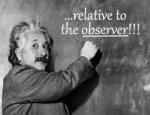
The salient point of Einstein’s theory of relativity is that spacetime only exists relative to observers—that there is no objective universe out there. This is not how the scientific community interprets it. They would say the relativity part only applies to our perception of spacetime, not to spacetime itself (it’s not ontic, but merely epistemic). I disagree, and side with physicist’s like John Wheeler. Essentially, the two postulates of special relativity say all the laws of physics are relative and conform to each observer. Why would that be?
The word “relativity” is just a science way of saying “subjectivity,” since the relative means relative to observers. Relative vs absolute translates to subjective vs objective. So, if all the laws of physics are subjective, then none of the laws are objective. A universe is governed by its laws. If there are no objective laws, there can’t be an objective universe.
If there’s no objective universe, then there is no objective causality, and Einstein came up with thought experiments to prove it. He noted, if spacetime always renders properly for every observer, paradoxes should occur in objective reality, proving it doesn’t really exist. This is explained to us in the form of Einstein’s thought experiments, but what is always left out is the main point: If they are correct, our common sense notion of an objective, physical spacetime must be wrong. We now know them to be correct.
Relativity was published before quantum mechanics, so it uses a classical framework. But we now know that framework is a mere approximation of the actual underlying quantum processes. Spacetime is warped by gravity, and gravity is caused by matter, but matter is entangled wave functions, so spacetime is warped by entangled wave functions.
I am not other than Light. The universe manifests at my glance. -Ashtavakra Gita
Einstein’s fabric of spacetime is the veil of Maya. And since this was such an outrageous claim for any scientist to argue, Einstein spent the rest of his long career trying to refute it. In fact, he tried so hard to falsify relativity, he altered the scientific method.
Perhaps the closest Einstein ever got to formally discussing the ontological implications of relativity was in his last publication on space, an introduction to the book, The Concepts of Space, by a close colleague of his, Max Jammer, where Einstein explains Jammer’s view on the nature of space:
…the whole of physical reality could perhaps be represented as a field… the introduction of an independent (absolute) space is no longer necessary. That which constitutes the spatial character of reality is then simply the four-dimensionality of the field. -Albert Einstein
In the book, Jammer describes Einstein as having this same view, though in a more scientific language (see example on p. 172-173).
Einstein’s relativity demonstrates how the laws of physics conform to our personal continuum of causal reality; that there is no objective universe out there. This ancient Buddhist quote most eloquently describes the implications of Einstein’s relativity:
What appears as a world of apparently external phenomena, is the play of energy of sentient beings. There is nothing external or separate from the individual. Everything that manifests in the individual’s field of experience is a continuum. -Pratītyasamutpāda
CONCLUSION
Science went tumbling down the rabbit hole with relativity and quantum mechanics, back in the early 1900’s. They literally found a paradoxical realm beneath space and time. Paradoxes that can be resolved only by abandoning their core belief in the idea of an objectively physical universe. Einstein’s relativity of simultaneity paradox tipped the philosophical needle back toward ontological idealism 120 years ago. But such an extraordinary shift in worldview required extraordinary evidence, so science set out to verify. Now it’s 120 years later, and they never found any evidence to refute it. All they’ve managed to do is accumulate a centuries worth of extraordinary evidence in support of it. Maybe it’s time we give up on the nihilistic worldview of the 1700’s, and accept the uplifting new science of the 1900’s. Here’s my argument.
Consciousness is more fundamental than mass, energy, space, & time.
Conclusion:
Consciousness creates the universe.
Why is there something, and not nothing? All life is the result of a singular consciousness localizing into organisms in a universe of its own creation. We are this consciousness, temporarily masquerading as humans …so, love your neighbor as yourself, because they are.
Buddha at the Gas Pump features free 1-2 hour interviews with awakened people, with a new interview every week. Over 700 interviews posted on YouTube:
Here are three fine examples of a BatGap interview. The first is a brilliant non-dual discussion with a swami, the second is a more rational, scientific discussion with a scientist, and the third is more of a philosophical look at science and spirituality (includes a bio, YouTube, and Podcast):
Conscious TV is also an extensive free resource for video interviews on spirituality from the UK. Over 400 interviews:
New Dimensions has been archiving 1 hour audio interviews, mostly on spiritual topics since 1973. Two new interviews are available for free listening each week, and you can pay a little to access Justine’s historic archive:
What if there was another level of being awake, where you realize the physical world is also a dream? A physical dream.
The world is illusory.
Brahman alone is real.
The world is Brahman.
-Ramana Maharshi
Thinking of reality as a dreamscape hardly sounds like science, but this is essentially what the founders of quantum mechanics discovered a century ago. Our modern physics community has yet to advance this culturally uplifting discovery despite how the last hundred years of experiments have only confirmed that consciousness is fundamental—all there really is.
Peter Russell | The Reality of Consciousness | YouTube 38:21
This is going to sound strange, but it shouldn’t. Consciousness is the only medium in which time flows. The physical world we know, including space and time, only exists as qualia in conscious experience, and otherwise is just a quantum sea of information, not in space or time. We make time (spacetime) in our own experience.
And there are plenty of other clues that this is a consciousness-based reality. Some are more obvious, like how the moon perfectly eclipses the sun, or the miracle of child birth, but there’s also many more subtle hints to find along the way. Like how the universe is so precisely tuned for life, or how spiral galaxies are vortices yet spin like wheels, or the impossible migration of nerve cells in a developing brain, or how epigenetic memories can pass through our single-cell life stage. We accept the world we are born into, but saints, scholars, and scientists have devoted their lives to a more clear-eyed view, and this is what they are telling us.
People like us, who believe in physics, know that the distinction between past, present, and future is only a stubbornly persistent illusion.
–Albert Einstein
The chances of our moon being just perfectly sized and located to exactly eclipse the sun but not its corona is infinitesimally small. Then factor in the likelihood of someone being here to appreciate it. Isn’t this the perfect clue to inform everyone on the planet that there are clues? Dreams are a big clue; more like a user’s manual. Every night we fall into deep sleep, but along the way we pass through our dreams. In a dream we have a body, and find ourselves in a world full of subjects and objects that seems quite real, but upon waking we realize all that space, those other people and places, were all just in our consciousness. Deep sleep is our consciousness waking up out of this physical dream. Our individual selves are just disassociated parts of our own universal consciousness looking out into the same mathematically stabilized dreamscape. Sometimes people wake up from this dream. We call them saints and sages.
Our consciousness has been compartmentalized down into individual egoic selves, and meditation helps us to re-associate with our true Self (the dreamer). When we look out into the world, it’s confusing, because everything is inside out.
Shakti opens her eyes and the universe is reabsorbed in pure consciousness; she closes them and the universe is manifested within her. -Spanda Karika
Modern science has long confirmed all this. Consider these quotes from notable physicists of the early to mid 1900’s:
Where does Space-Time come from? Is there any answer except that it comes from consciousness? –John Wheeler
I regard consciousness as fundamental. I regard matter as derivative from consciousness. –Max Planck
Consciousness cannot be accounted for in physical terms. For consciousness is absolutely fundamental. –Erwin Schrödinger
The very study of the physical world leads to the conclusion that the concept of consciousness is an ultimate reality. -Eugene Wigner
The universe begins to look more like a great thought than a great machine. –Sir James Jeans
How is this different from what the saints and sages (meditators) have been saying for millennia?
In the absolute sense, subject and object are nothing other than the space of profound consciousness. -Spanda Karika
Universal consciousness is the cause of the universe. -Pratyabhijnahrdayam
Matter derives from mind not mind from matter. –Tibetan Book of the Great Liberation
The world you perceive is made of consciousness: what you call matter is consciousness itself. -Nisargadatta
What appears as a world of apparently external phenomena, is the play of energy of sentient beings. -Pratītyasamutpāda
The world in which we live is a play of universal Consciousness.
-Swami Muktananda | Play of Consciousness
Consciousness is everywhere, there is no differentiation…What you call universe is an illusion, a magical appearance. To be happy, consider it as such. -Vijñānabhairava
[Buddha said,] My dreamlike form
Appeared to dreamlike beings
To show them the dreamlike path
That leads to dreamlike enlightenment.
-Bhadrakalpa Sutra
According to relativity and quantum mechanics, the nature of the universe is built around the observer. So why is today’s scientific view so antithetical to the primacy of consciousness when their own data has revealed it to be so? One reason may be because in the 1700’s, science claimed authority over the church as purveyors of the highest truth, and relativity and quantum mechanics point back toward the mystics.
The similarity to Eastern spirituality is obvious. Even the preeminent physicist Erwin Schrödinger wrote about the Upanishads (from What is Life in 1944 to My View of the World in 1964). By the 1960’s, Hippies learned of these experiments, and ideas about vibrations and universal consciousness infused into popular culture, eventually becoming the New Age movement.
After these conversations with Tagore, some of the ideas that had seemed so crazy suddenly made much more sense. That was a great help for me.
–Werner Heisenberg
Saying the universe only exists in the experience of it is an extraordinary claim, but after a century of trying to disprove it, science has amassed an extraordinary amount of evidence in favor of it. It’s time now for scientists to live up to their authority as purveyors of the truth. But when they do, old hippies will say, we told you so, and so will some religions.
Just as quantum mechanics revealed the subjectivity of matter and energy, relativity revealed the subjectivity of space and time. You might say, physics is now investigating Kant’s noumena—the substrate of reality we weren’t meant to see. What insights can be gained by this?
Below is a beautiful NOVA documentary highlighting an experiment that went to the ends of the known universe to rule out local hidden variables (hidden variables are a last-ditch effort of the materialist view). Why go to such trouble? Because, saying there’s a quantum realm which gives rise to space and time, but only when observed, is an extraordinary claim, and they needed extraordinary evidence.
Einstein’s Quantum Riddle | Full Documentary | NOVA | PBS | YouTube 53:18
To be full of things is to be empty
of God. To be empty of things is to
be full of God. –Meister Eckhart
Knowledge is bondage.
-Shiva Sutras
Silence is the language of god,
all else is poor translation.
-Rumi
Entering into the unitive state, he attains the goal of evolution.
-Paramahamsa Upanishad
For one gains by losing
and loses by gaining.
-Tao Te Ching
Silent meditation is unique in that it’s the only activity which points us back toward our true nature. The only thing masking the infinite is that we are always looking at our minds and senses. Meditation is looking back toward consciousness itself.
The spiritual path has two parts: preparation and practice. The prep is mostly about purifying yourself, if need be, and the practice is meditation.
Purification happens by leading with love rather than fear, shedding bad habits, and the easing off of egoic attachments altogether. But there’s also the mental skills prep work, called metacognition and immediacy (mindfulness). Metacognition is paying attention to your thought processes; observing your mind in daily life. Immediacy is applying metacognition to stay keenly present in the moment for extended periods of time. This could be a practice of listening to the birds while consciously monitoring and omitting any internal dialogue. Professional birders can go hours, acutely focused only on their senses. This is tremendous help in mediation, because it’s the same skill that enables a focus on just the breath, or just a mantra, or just nothing.
The practice of meditation is like surfing. In surfing, you need to start with the right equipment (lead by love), but you also need to develop skills, like knowing how to swim, reading ocean conditions (mindfulness). Then you need to pick a good spot (next to a guru), gear up and paddle out to the line-up, then just sit there (meditate). But even then, there is no guarantee a wave (grace) will come to you. If it does, you need to be ready for it in that moment (present but without thoughts), to catch that wave (for grace to find you).
There’s so much more to us hiding just below the surface that they call it grace. Meditation makes you much more available to grace, and if you meditate with a true guru your chances are better, because they are conduits for grace.
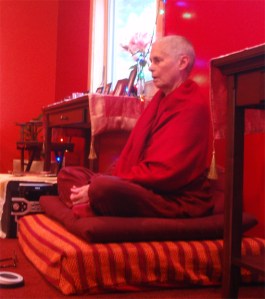
Swami Girijananda Meditating
There are many techniques which are
supposed to lead us to God, but, of
all these, meditation is the one
recognized by all the saints and sages
because only in meditation can we see
the inner Self directly.
-Swami Muktananda | Meditate
Unity obtains when the activities
of mind have ceased. The witness then
abides in its true nature. Otherwise,
the witness is identified with the
activities of mind and is just another
thought-form itself.
-Yoga Sutras
The Self is realized in a higher state
of consciousness when you have broken
through the wrong identification that
you are the body…
-Kena Upanishad
In the depths of meditation, sages saw
within themselves the Lord of Love, who
dwells in the heart of every creature.
-Shvetashvatara Upanishad
If your goal in meditation truly is enlightenment, be advised, the greater the shift in perspective, the more destabilizing it can be for your psyche if the necessary prep work hasn’t been done. What you’re asking for is bigger than anything of this world, and it’s very personal. You might want to prep first by, among other things, loosening your grip on your worldview, because that’s going to shift in unexpected ways. If your goal is still enlightenment, note that being “enlightened” means dropping your body; you likely don’t want that. What you’re most likely looking for is more of a temporary enlightenment experience that sticks with you for the rest of your life. This is the real next step, and it’s called a spiritual awakening.
Here’s an ancient strategy from Kashmir Shaivism for finding the method that best suites you. Start with the quickest method and work from there. First, simply realize that you already are what you are seeking, and your “spiritual journey” is complete. That could work, but if doesn’t, try silent meditation (looking toward consciousness itself). That should work, but if your mind wanders too much for that, add a mantra meditation, or watch your breath to stay focused. If your thoughts still keep interrupting, try a yoga class with a short meditation at the end. If you still can’t quiet that internal narrative, maybe just get back to the business of living, and come back to this when you can quiet your mind. For a few people, realization is instantaneous, but for the rest of us, it requires a little patience.
How to meditate.
Tao is self-evident to one with no preferences. When like and dislike are absent, the Real is obvious and clear. Make the slightest distinction, however, and it appears disguised as heaven and earth. -Xinxin Ming
The goal of meditation isn’t to achieve something, but to reveal the ground-stuff of your being, by getting all the noise out of the way.
I have lived on the lip of insanity,
wanting to know reasons,
knocking on a door.
It opens.
I’ve been knocking from the inside.
-Rumi
When first trying to meditate, most people find it hard not to think. Parts of our brain are always trying to process some emotion, and our consciousness keeps getting distracted. Meditation is about learning how to extend the time between our worldly thoughts. Adyashanti would say something like, if you take your foot off the gas pedal, eventually the car will come to a stop.
The amount of practice it will take to go thoughtless for short periods depends on how much attention our thoughts are requiring. Practice makes perfect, and if one practices even a few minutes a day, it will get easier. Meditation is like taking the ultimate break from the day; to step out for a second. Relax, maybe starting at the base of the spine, and just practice being aware without thoughts.
The more you process those thoughts, the easier it gets, until eventually a thoughtless state becomes a familiar resource you can easily drop into. Spending time there each day will refresh you, but it will also make you much more available to grace.
Here is an excellent introduction to why people meditate, with a little at the end on how to meditate.
Why Meditate | Joel Morwood | Vimeo 10:31
It cannot be perceived by the mind, because it makes the mind think. Still, the Self can be known, and to know it we do not need the help of the mind or the senses. -Swami Muktananda | I Am That
And being asked by the Pharisees, when the kingdom of God cometh, [Jesus] answered them and said, The kingdom of God cometh not with observation…the kingdom of God is within you. -Luke 17:20-21 | KJV
That which makes the mind think but cannot be thought by the mind, that is the Self indeed. This Self is not someone other than you.
-Kena Upanishad
The Self is one, though it appears to be many. Those who meditate upon the Self…see the Self in everyone… -Chandogya Upanishad
The eye with which I see God is the same eye with which God sees me. My eye and God’s eye is one eye… –Meister Eckhart
God sleeps in the rock, dreams in the plant, stirs in the animal, and awakens in man. -Ibn Arabi
Wake up from this dream of separateness.
-Shvetashvatara Upanishad
So all of us who have had that veil removed can see and reflect the glory of the Lord. And the Lord—who is the Spirit—makes us more and more like him as we are changed into his glorious image. -2 Corinthians 3:18 | NLT
Consciousness can localize into matter. When it does, we call it life.
…I am the life in every creature… -Bhagavad Gita | 7:9
What caused matter on this planet to organize into living organisms? Science still has no idea. Why? Because they religiously ignore consciousness. Without it, all they’ve been able to do is generate lists of attributes to describe life. But these are only descriptions, not explanations. If we could design a robot with these attributes, would it suddenly become alive? It’s intuitively obvious that the missing ingredient is consciousness.
Consciousness is what makes the mind-body problem really intractable. Perhaps that is why current discussions of the problem give it little attention or get it obviously wrong. -Thomas Nagel | What is it like to be a bat?
There are plenty of physical theories for consciousness, but they all rely on mysterious tricks to transform mass-energy into conscious experience. And modern physics is no help. They say it’s the other way around. They say, conscious experience causes mass-energy to manifest out of nonphysical quantum fields.
Common to all life is the basic desire to move toward what feels good, and away from what feels bad. But isn’t consciousness the only thing that can ever feel? Isn’t that what we mean by sentient?
Because of my life as a wildlife biologist, I’ve handled thousands of wild animals (mammals, birds, fish, but mostly amphibians & reptiles) and I can personally assure you, they were all conscious and exhibited emotions—their behavior would always betray their feelings. In fact, they behaved as I would if I were them (that’s a nonduality joke). We know animals are conscious and can feel. Why else would we have an ethical oversight committee to approve and monitor all our wildlife interactions?
Creatures are loved not for their own sake, but because the Self lives within them. -Brihadaranyaka Upanishad
Animals experience the same feelings we do. The main difference between humans and other animals is our intelligence; not our feelings.
Recent advances in Artificial intelligence highlight the difference between intelligence and feelings. AI is becoming exceedingly good at imitating human intelligence, even our emotional intelligence, but no coder has any idea how to make a computer conscious. In contrast, all organisms are conscious and can feel.
Furthermore, what do we mean when we say an organism is dead? Don’t we mean that its consciousness is gone? Isn’t that what we mourn? So, don’t we already equate life with consciousness? Being alive means there is consciousness perceiving the inputs from its sense receptors, wanting to feel good, and when consciousness can’t live in that matter anymore, we say the organism is dead.
Death in the Microcosmos | YouTube 7:20
Today’s scientific community assumes that consciousness emerges from the brain, despite discovering that single-celled organisms behave consciously, and even form memories. To this day, there is still no real evidence that brains create consciousness, or even store memories. We’ve only confirmed that it facilitates consciousness and provides links to memories.
It’s still scientifically reasonable to speculate that the brain is only a complex interface between consciousness and matter, and that all cells are conscious to some degree. The mystical idea that consciousness comes from a deeper source than matter is still consistent with our findings in physics and neuroscience.
Consciousness is like the electricity in a computer. A computer has a body and a brain that runs programs and has memories, but it needs electricity to come alive. We have a body and a brain that runs thoughts, feelings, and has memories, but it needs consciousness to come alive. And just as electricity is completely different than the programs and memories of a computer, consciousness is completely different from our thoughts, feelings, and memories. Also, note that it’s the same electricity running through all computers (in the area), just as it’s the same consciousness running through all of us (lifeforms). It’s only the thoughts, memories, and bodies that are unique to each individual; though some lifeforms are more like a lightbulb than a computer. This was discovered by researchers meditating on consciousness thousands of years ago. When we identify with our thoughts, memories, and bodies, we see ourselves as separate. But when we identify with consciousness, we humans can quickly see past that limited illusion of separateness.
Exercise: Watch these YouTubes’ while asking yourself if these organisms are conscious of their surroundings.
World’s Most Adorable Badger – The Dodo Comeback Kids | YouTube 5:39
Kung Fu Mantis Vs Jumping Spider – Life Story – BBC | YouTube 4:07
What Plants Talk About | NATURE | Vimeo 52:57
Are we really just biological machines in a meaningless universe of physical processes? Why is the machine metaphor better than the organism metaphor when trying to understand life, the universe, and everything?
We quickly learn to take for granted this impossible world we are born into. Set aside your default blinders for a minute, and with fresh eyes, see how freaky the miracle of life really is. Then you will see there are mystic clues everywhere.


 that spacetime only exists relative to observers—that there is no objective universe out there. This is not how the scientific community interprets it. They would say the relativity part only applies to our perception of spacetime, not to spacetime itself (it’s not ontic, but merely epistemic). I disagree, and side with physicist’s like


 Because of my life as a wildlife biologist, I’ve handled thousands of wild animals (mammals, birds, fish, but mostly amphibians & reptiles) and I can personally assure you, they were all conscious and exhibited emotions—their behavior would always betray their feelings. In fact, they behaved as I would if I were them (that’s a nonduality joke). We know animals are conscious and can feel. Why else would we have an
  Nonduality in Science