Believing appearances are real,
you cannot see their Source.
-Xinxin Ming
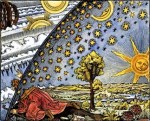
A century ago, physicists experienced a paradigm shift so worldview shattering they still don’t like to talk about it. Einstein’s 1905 publications led to the realization that mathematics is the substrate behind the universe—when their math began to perfectly map reality. Mathematics is a language, which means there must be consciousness behind the math. Shaken by the implications, physics just stopped talking philosophy altogether, and focused solely on verification. By the 1950s, they’d established a “shut up and calculate” policy in physics classes and removed philosophy classes from the curriculum, effectively removing philosophy from physics. Why? Because the students could see for themselves, and wouldn’t stop asking deeply philosophical questions.
Position and velocity are what you can
observe. But until you measure them, they
don’t exist. Only the wave function does.
-Sean Carroll
Since physicists aren’t talking, we assume they’re all still materialists with the commonsense view of a physically deterministic universe. The alternative is to tell us the crazy truth that matter is not physical when it’s not interacting with us (living organisms). And when we do interact with it, its location is governed by wave functions. The actual wave functions and quantum fields are not physical. They are mathematical functions, like y=x+3. And the same goes for Einstein’s spacetime manifold. What they are describing can’t be anything other than mathematical. And this is where we stand today. We know the structure of the universe is math on the outside, consciousness on the inside. A century of experimentation only keeps confirming it.
It’s a problem. As far as matter goes, there is no experimental evidence for objective collapse of wave functions (into particles of matter), and a century of evidence for subjective collapse. The evidence for unobserved matter existing non-physically started in 1905, with Einstein demonstrating that light can behave as a particle (photoelectric effect). Which led to experiments showing electrons (particles of matter) behaving as quantum wave functions in 1927 (Born Rule). The idea was experimentally reconfirmed in 1982 (Bell’s inequalities), and then again in 2012 (Leggett-Garg Inequalities).
The problem has famously been summed up as the Measurement Problem. To sweep the problem under the rug, physicists altered the meaning of the word “observer” (from the Copenhagen interpretation) to include “measurement,” which doesn’t require an observer. That way, the environment can collapse its own wave functions, allowing for physical determinism to proceed without observation, and materialism remains intact. This is conflating decoherence with collapse, but it lets us think of the Big Bang as an explosion of particles in expanding space, rather than a wave function storm in a mathematical space. Also, we get to think of rocks as independently physical, instead of tightly entangled groups of wave functions that only appear physical in subjective experience…along with their history dating back to the quantum storm of 13.8 billion BC; crazy that. But this is what a century of experimentation is telling us. It is a quantum universe. Objects are only physical in experience.
We are participators in bringing into being
not only the near and here, but the
far away and long ago. –John Wheeler
When not observed, wave functions behave according to the strict determinism of mathematics, which we mistake for physical determinism. The quantum probability part we always hear about only happens in observation. For the rest of the time, the universe evolves according to the mathematical precision of quantum determinism. This is what the Schrödinger equation models so precisely (up to 12 decimal places).
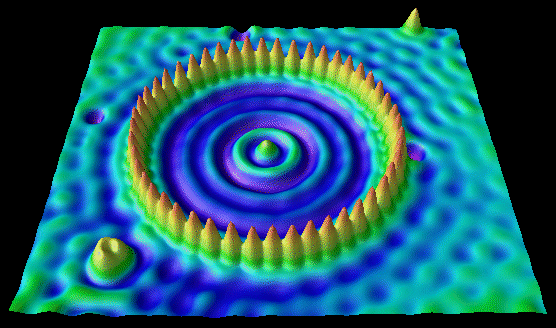
Wave functions behave like particles when they scale down to that size range, like the iron atom wave functions of the corral in the above image. They also entangle (stick) together, so you can build tables out of them.
Classical systems have localized wave functions that approximately obey classical equations. -Sean Carroll on the Ehrenfest theorem
Let’s get a little perspective on the situation for a moment. For 2,000 years, Western science assumed God created heaven and earth. Then, for 200 years and ending 100 years ago, the evidence pointed toward the nihilism of materialism, when they discovered that the world is not the center of the universe, but one planet among billions, spinning like a top while getting dragged around by a star in a galaxy of the Virgo supercluster. But now, a new science has seen past all that, and is pointing back toward a universal consciousness that is at the core of our existence.
Modern experiments tell us our consciousness acts like a catalyst, localizing wave functions into our experience of the physical world from an otherwise nonlocal domain. Why would that be? The simplest explanation is, our consciousness is this nonlocal consciousness, just localized into a body; compartmentalized and disassociated from the rest of ourselves—like in a dream, we are always looking out toward our mind & body, we rarely notice our nonlocal inner nature. Top physicists discovered all this a century ago, and this is how they talked about it:
The universe is of the nature of a thought or
sensation in a universal Mind…The stuff of the
world is mind-stuff. –Sir Arthur Eddington
As a man who has devoted his whole life
to the most clearheaded science, to the
study of matter, I can tell you as a
result of my research about the atoms
this much: There is no matter as such!
All matter originates and exists only
by virtue of a force…We must assume
behind this force the existence of a
conscious and intelligent Mind. This
Mind is the matrix of all matter.
–Max Planck
The universe does not exist “out there”,
independent of us. We are inescapably
involved in bringing about that which
appears to be happening…Today we
demand of physics some understanding
of existence itself. –John Wheeler
If this is shaking up your worldview at all, then it’s good prep work for meditation.
WHAT ARE WE?
We are consciousness. Our mind and body are earthly accumulations. Scientists found the building blocks of our accumulations to be a mathematical language in the form of quantum wave functions. That there is a mathematical language giving rise to reality tells us there is consciousness on the other side of wave functions as well. So, the source of the universe appears to be consciousness. What we are.
God dreams in the language of mathematics. That’s why the world is so stable. We lifeforms are the dream avatars.
Math is so ubiquitous in the natural world, ancient Greeks could see it. It’s even found in living organisms. Sometimes, the same formula is even repurposed for different tasks. For example, the Schrodinger equation of quantum mechanics is essentially a heat flow equation borrowed from classical physics. That’s nuts. Now, modern physics studies the actual mathematical structure behind the world. It’s considered a physical primitive at major physics conferences. They treat the event horizon of black holes as exposed mathematical substrate, with no spacetime volume inside. We don’t hear about it, because most scientists don’t publicly philosophize.
…the enormous usefulness of mathematics in the natural sciences is something bordering on the mysterious and that there is no rational explanation for it. -Eugene Wigner | The Unreasonable Effectiveness of Mathematics (1960)
If you think quantum mechanics sounds more like a simulation than a dream, I agree. It behaves like a simulation as opposed to a model, but it’s still a dream, because we are real. For all we know, wave functions are brainwaves. The real question is, is the consciousness that’s behind the simulation another being, or consciousness itself? Each component in the simulation is governed by a model (a wave function), which describes its location and shape within the rules (Hamiltonian) of the simulated environment (Hilbert space), but our consciousness is certainly not part of the simulation. It’s for sure real. If it’s just a being like us behind the simulation, then there must be a real universe to house this being, and the simulation theory just inherited all the problems of materialism. And our consciousness must be piped into the simulation; us billions of humans, along with the countless lifeforms of earth (can’t all be NPCs) must be accounted for outside the simulation, and that gets messy.
That’s why simulation theorists tend to argue the simulation itself must generate our consciousness. But how can the simulated appearance of a brain make anything? Real brains can’t even make consciousness. Quantum mechanics tells us consciousness makes matter, not the other way around. The simulation theory is a dualism that can’t explain consciousness.
In contrast, the nondual view that consciousness itself is behind the simulation, solves the First Cause paradox, solves the Hard Problem of Consciousness, and the Measurement Problem, explains all phenomena, has far fewer assumptions than all other alternatives, and is personally verifiable. If your consciousness is what’s most real, then maybe consciousness is what’s most real.
And this is when the philosophers cry solipsism. They say, we can only be certain of our own consciousness, but not anyone else’s. This argument is logically valid, but is only a problem if you think your consciousness is limited to you. The nondual view is that one consciousness inhabits all sentient beings, and only misidentifies as individuals. Maybe we can’t logically deduce nonduality by staring into a loved ones eyes, but solipsism doesn’t disprove it. The fact remains. We can only be certain of our own conscious. Everything else is inference.
So, what are we? Our experience here on earth is a mix of Consciousness & Information—Will & Representation, Shiva & Shakti, Purusha & Prakriti, God & Creation. We are that.
Why isn’t this common knowledge? Because no scientist wants to defend such a position. It’s counterintuitive, abstract, anthropocentric, and sounds like religious wishful thinking. It’s far less controversial to suggest there must be some means of objective collapse, allowing the universe to physically unfold from the Big Bang. Too bad, really. Society could have used the good news.
Whatever exists, animate or inanimate, is born through the union of the field and its Knower. -Bhagavad Gita
Matter (mass-energy) is a property of three quantum fields (up quark, down quark, & electron) held together by two other quantum fields (electromagnetic & strong nuclear). Physicists have no idea what causes these fields, but they can predict their behavior so astonishingly well, they clearly are mathematical. And this is the quantum determinism we misinterpret as physical determinism (the quantum probability part still only happens in observation). So, the deterministic nature of our world stems not from the physical, but the mathematical. When this was first published in 1926, the author was quite concerned. So far, this conclusion still stands.
Is the universe really mathematical? The quantum rules describing the universe (the Hamiltonian) only make sense if you think of them operating within a mathematical space (Hilbert space). Mass is a property of quantum fields, not of wave functions or particles—the wave function only locates the particle in space, but the field it belongs to dictates the particles properties. So, what is a particle? The quantum domain is a variable-dimensional space (likely infinite dimensions), where imaginary numbers are real, and time needs to be added. Mass, charge, and spin magnitude are just numbers (constants) in formulas. A quantum field is a Hilbert space. The true state of the universe is a high-dimensional mathematical space. One example: The spin–orbit interaction parameter, must know and use the tensor-product structure of the Hilbert space in its formula—It’s behaving in ways that can only be mathematical. The point I keep stressing is, science discovered the true structure of the universe, and it’s mathematical. Why would that be?
The fact that you cannot separate the original matter from the deeper reality tells you this is a monism. – Federico Faggin
Physicists still like to say you don’t need an observer, just a measuring device to collapse the wave function into a particle. I disagree. There is nothing intrinsically different between the sample and the measuring device; they are both matter. On its own, matter resides in quantum superposition, and if we were only matter, we would exist in superposition as well. But since we don’t, there clearly must be something intrinsically different about us (lifeforms), an extra-physical element, that causes physicality. The obvious difference is, we are conscious. Why all the confusion about this?
A measurement without an observer is just decoherence of the superposition, and not collapse of the wave function. Decoherence and collapse can appear to be the same from our perspective, in that a measuring device can measure a mathematically precise outcome while still in superposition, but one is physically in spacetime and the other is not. It’s more correct to think of the objects in the universe as fields of structured quantum probabilities, rather than a collection of particles. Only the observed parts reduce to particles.
What does the Heisenberg Uncertainty Principle tells us? It’s another proof that particles are a mathematical illusion. When observed, wave functions collapse into aspects of particles only; never complete particles—If you could know a particles exact velocity, it’s position would be anywhere in the universe. It’s confirmation that everything is wave functions, and particles are what happens when we interact with them.
We are mixed up about the word entanglement—how wave functions combine to make the classical-scale objects we experience. The quantum entanglement everyone talks about (SPDC entanglement) is when a single wave function is split into two particles, allowing them to relate to each other at paradoxically faster than light speeds. But the far more common version of entanglement is when different wave functions interact with each other to make all the classical-scale physical objects we know and love—like ripples on a pond interacting to make more complex patterns. They call this form of entanglement, decoherence, and it’s how unobserved history develops deterministically while remaining in superposition (not physically in spacetime).
What did we learn from the double-slit experiments? They conclusively demonstrate how light and matter operate in Hilbert space (a mathematical domain) until they are observed—proof that physical objects only exist in the experience of it. If you try to view the delayed-choice experiment from a classical spacetime perspective, it generates the paradox of retrocausality, telling us it’s an incorrect perspective. The results only makes sense if you think of light “moving” through the apparatus as a wave function, not yet in time or space. Likewise, sunlight in your room does not propagate through your room, but as information in Hilbert space. Matter rests in Hilbert space too. It only transitions into spacetime in the experience of it. The double-slit experiments prove the world is an illusion (māyā).
Quantum applies to all scales. The reason why scientists were looking into those tiny quantum scales was to find the building blocks of matter. In that endeavor, they were successful. But what they found was crazymaking. The building blocks turned out to be a mathematical language operating outside of spacetime. Maybe that’s why physicists limit their quantum talk to the strange phenomena happening at quantum scales—keeps it abstract. But since the building blocks of classical are quantum, it’s clear that classical is quantum too. Our world is what quantum looks like at this scale. Quantum mechanics explains all classical scale phenomena, and magnets can help us understand how this works. Magnetism is caused by the spin of individual electrons in atoms, and usually aren’t noticeable at classical scales. It’s only when enough electron spins get set into alignment, as in magnetized iron, does this quantum phenomena reach into classical scales. But this is also how everything classical works. All classical phenomena are a result of quantum processes (interacting with consciousness).
The way we think about quantum is all wrong. Classical physics is just a mathematical shortcut to model the behavior of large-scale quantum objects. At what size would we even make the break between quantum and classical? In certain conditions, matter can maintain quantum coherence and behave like a single wave function at classical scales. Typically, the more wave functions involved, the less likely they will all be waving coherently together (resulting in decoherence), but there are examples of large-scale coherent objects, such as lasers, superfluids, superconductivity, and Bose Einstein condensates.
To sum things up, mathematical information is currently thought to be the building blocks of all physical objects. Unobserved matter, and even its history, never physically exists, except as qualia in experience. The universe is math on the outside, and consciousness on the inside. What does that do to your worldview?
The rest of this segment just gets into greater detail. Here’s a quick YouTube describing the behind the scenes side of matter:
What Is a Field? – Instant Egghead #42 | YouTube 2:21
This next YouTube beautifully details how a single wave function collapses into particles as they are observed, and how the wave function progresses after collapse. However, be advised: They say the detector is collapsing the quantum states, but that is only decoherence, not collapse (note there is a yes zone, not a point). In reality, the detector, as well as its detection history, remain in superposition until collapsed by observation (the Heisenberg chain breaks at observation).
Visualization of Quantum Physics (Quantum Mechanics) | YouTube 14:33
Science has long been wanting to tell us that beneath the surface, we are all one. Below is a Cambridge professor explaining how all the universe reduces to quantum fields (19 minutes into his Faraday’s Fields talk).
Quantum Fields: The Real Building Blocks of the Universe – with David Tong | YouTube 1:00:17
So, these fields contain information, which collapse when observed by the light of consciousness. And any lifeform will do. This scientific conclusion was formalized as the von Neumann–Wigner interpretation of the Copenhagen interpretation.
For example, the moment before a photon registers in your awareness, its wave function (in Hilbert space) may span many light years in spacetime. It could have collapsed into the eye of a distant observer on another planet (hypothetically speaking), but the moment it collapsed into your eye, it instantly became unavailable to any other observer, and the entire history of its trajectory became a spacetime event. The only way this information could be conveyed across light years in an instant is if it wasn’t actually a thing in spacetime. Everything in the universe is like this. Before it is observed it is only information in Hilbert space, and not really a thing in the universe.
This quantum substrate has long been described by saints and sages (meditators). For example, the Bhagavad Gita devotes a chapter to quantum fields, and the Spanda Karika (sacred tremor) is a 9th century text about wave functions.
The sacred tremor,
the very place of creation and return,
is completely limitless because
its nature is formless.
-Spanda Karika
Returning is the motion of the Tao.
Yielding is the way of the Tao.
The ten thousand things are born of being.
Being is born of not being.
-Tao Te Ching
Without effort the [Self] encompasses both
the movable and the unchanging,
the manifest and the unmanifest.
-Avadhuta Gita
Universal Consciousness unfolds
the universe on its own screen…
[It] brings about all emanation
and reabsorption of the universe.
-Pratyabhijnahridayam
Though all the galaxies emerge from him,
he is without form and unconditioned.
-Tejobindu Upanishad
That which has form is not real.
Only the formless is permanent.
Once this is known, you will not
return to illusion.
-Ashtavakra Gita
O Seeker, form does not differ from emptiness…
All appearances are emptiness…
No mind, no fear.
The imagined world is seen through.
Nirvana.
-Heart Sutra
THE THEORY OF RELATIVITY
To be is to be perceived.
–George Berkeley
The salient point of Einstein’s theory of relativity is that spacetime only exists relative to observers (no objective universe). This is not how the scientific community interprets it. They would say relativity only applies to our perception of spacetime, not to spacetime itself (not ontic, but merely epistemic). I disagree, and side with physicist’s like John Wheeler. Einstein himself would not defend the ontic view, but he often treated relativity that way. And more so as he got older. Essentially, the two postulates of special relativity say all the laws of physics are relative and conform to each observer. Why would that be?
The word “relativity” is just a science way of saying “subjectivity,” since the relative means relative to observers. Relative vs absolute translates to subjective vs objective. So, if all the laws of physics are subjective, then none of the laws are objective. A universe is governed by its laws. If there are no objective laws, there can’t be an objective universe.
If there’s no objective universe, then there is no objective causality, and Einstein came up with thought experiments to prove it. He noted, if spacetime always renders properly for every observer, paradoxes should occur in what we call objective reality, proving it doesn’t exist. This is always explained to us in the form of Einstein’s Thought Experiments, but what is always left out is the main point: If they are correct, our common sense notion of an objective, physical spacetime must be wrong. We now know them to be correct.
Relativity was published before quantum mechanics, so it uses a classical framework. But now we know that framework is a mere approximation of the actual underlying quantum processes. The spacetime manifold is warped by gravity, which is caused by matter, which is entangled wave functions.

But Einstein was well out ahead of the game. Relativity has always said spacetime reduces to math. His spacetime is a 4‑dimensional differentiable manifold with a Lorentzian metric, and can only be mathematical.
And since all this was such an outrageous ontological claim, Einstein spent the rest of his long career trying to refute relativity, rather than exalting it. He did such a good job, he altered the scientific method. Perhaps the closest Einstein ever got to formally discussing the ontological implications of relativity was in his last publication on space, an introduction to the book, The Concepts of Space, by a close colleague of his, Max Jammer, where Einstein explains Jammer’s view on the nature of space:
…the whole of physical reality could
perhaps be represented as a field…
the introduction of an independent
(absolute) space is no longer necessary.
That which constitutes the spatial
character of reality is then simply
the four-dimensionality of the field.
-Albert Einstein
In the book, Jammer describes Einstein as having this same view (though he used more scientific jargon; see example on p. 172-173). Einstein did not object.
Einstein’s relativity demonstrates how the laws of physics conform to our personal continuum of causal reality; that there is no objective universe out there. This ancient Buddhist quote most eloquently describes the implications of Einstein’s relativity:
What appears as a world of
apparently external phenomena, is
the play of energy of sentient beings.
There is nothing external or separate
from the individual. Everything that
manifests in the individual’s field
of experience is a continuum.
-Pratītyasamutpāda
CONCLUSION
Physics went tumbling down the rabbit hole back in the early 1900s, with relativity and quantum mechanics. They found paradoxes that could only be resolved by abandoning their core belief in an objectively physical universe. Einstein’s relativity of simultaneity paradox started this paradigm shift toward nondualsim, but such an extraordinary shift in worldview requires extraordinary evidence. That’s why they’ve spent the last century amassing an extraordinary amount of extraordinary evidence. And now, maybe it’s time for us to accept this uplifting paradigm shift that modern physics has been quietly offering us.
What I’m trying to say is, if the Mary’s Room argument invalidated physical monism for you, and you’re not satisfied with Cartesian dualism, you might want to try the most parsimonious of the monisms; idealism (nondualism):
Premises:
- We can be absolutely certain only that we are consciousness; everything else is inference
- Physics says the universe is fundamentally mathematical
- Mathematics only exists as a function of consciousness
Conclusion:
- The universe is an expression of consciousness
How is it that we are here? All life is the result of a singular consciousness localizing into organisms in a universe of its own creation. We are this consciousness, temporarily masquerading as humans …so, love your neighbor as yourself, because they are.

